


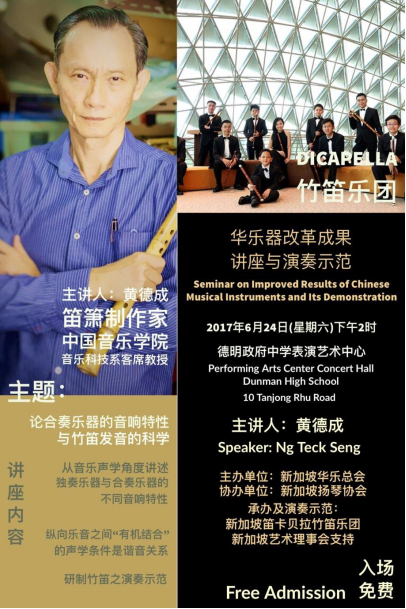
Public Seminar at Dunman High School 24 June 2017
发布者:Ng Teck Seng2018-09-20
The Acoustic Characteristics of “Ensemble Musical Instrument & the Acoustic Science of Chinese Bamboo Flute
Synopsis
From “solo musical instrument” to “ensemble musical instrument”.
The acoustic science of “ensemble musical instrument”.
The identification of standard dimension of the musical instrument and its variation.
The global influence of “ensemble music instrument”.
The acoustic science of Chinese bamboo Flute (DI-ZI) Playing demonstration: DICAPELLA Bamboo Flute Ensemble
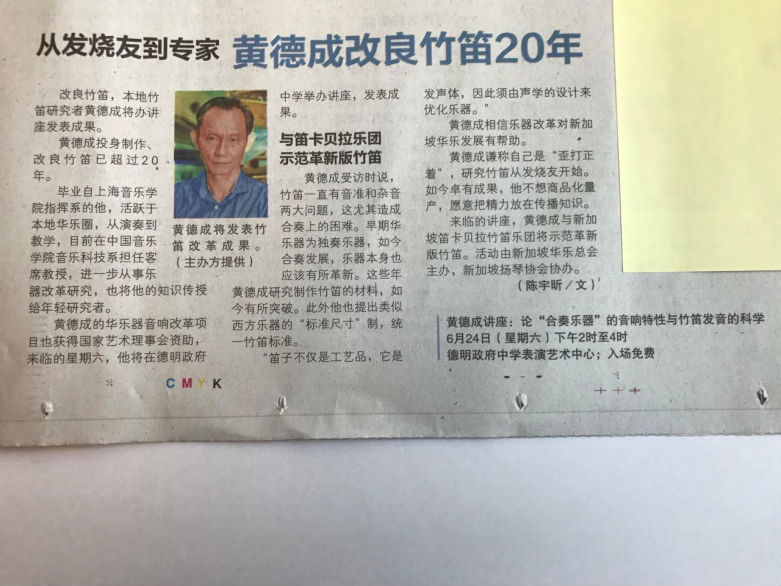
Feature of Seminar by Zaobao – Zaobao Now Art Section on 22 June 2017
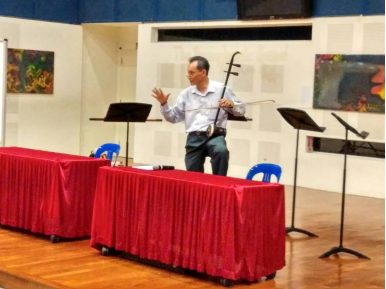
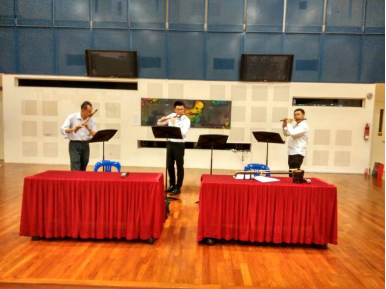
Mr Ng talked on various aspects of the results, as well as demonstration, together with Dicapella
|
|
|
|
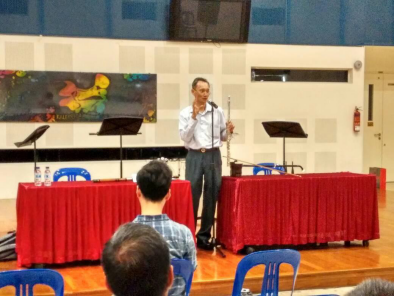
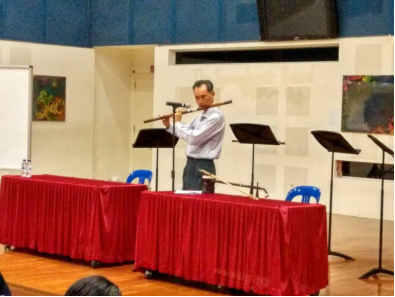
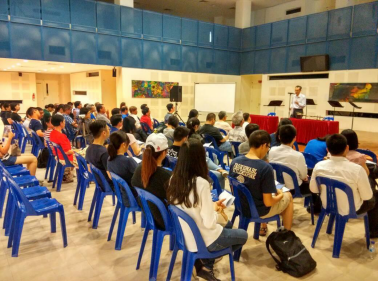
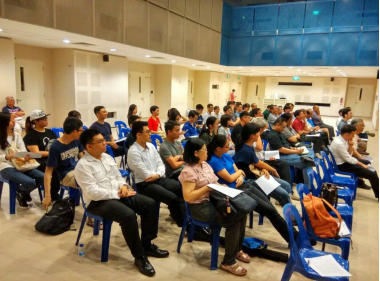
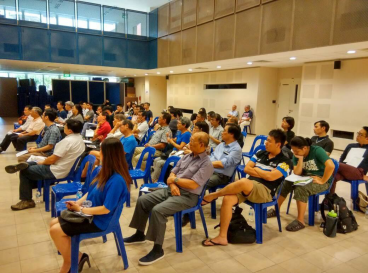
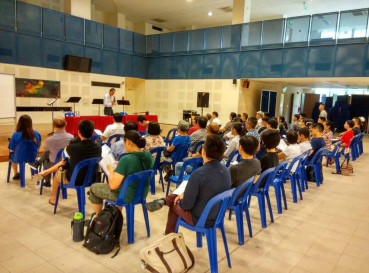
More than 50 participants listened attentively.
|
|
|
|
Seminar is uploaded to Youtube for public viewing and continuous dissemination.
Part 1: https://youtu.be/hJ0jxJ4Td6Q
Part 2: https://youtu.be/QeCdbLtN6UE
Part 3: https://youtu.be/ymi1S5zdyi4
Part 4: https://youtu.be/ztbVCoP5tMo
Part 5: https://youtu.be/XE7j41NJPhY
Seminar handouts given to the audience.
The Acoustic Characteristic of the “Ensemble Musical Instrument” & The Acoustics Science of the Chinese Bamboo Flute
The current Chinese musical instrument for ensemble has encountered many acoustic disharmony and noise problems. The main reason of these problems are due to the out dated way in making technic and lacking the process of acoustics modernization. Particularly, in the material science and music acoustics study, we are far behind the western music.
In order to achieve breakthrough in this perennial issue, we first need to differentiate the acoustic data between traditional Chinese musical instrument (which initially were not designed for modern orchestration and ensemble) and “ensemble musical instrument”, in a scientific way.
In the past 20 years, I not only focused on improving its craftsmanship as most people do, but also on mastering the material acoustic characteristic in the combination of the standard size finding, in order to find out the axis of standard dimension on DI-ZI & ER-HU, as what violin and other western instruments do. After numerous times of experiments, our research has shown that, there won’t be any absolute dimension like the carpenter making furniture. Instead, we always need to make subtle adjustment to find out the best resonance of a particular instrument. Indeed, the craftsmanship of musical instrument supposed to be an extremely complicated acoustics design.
Making finest DI-ZI, will not only depend on excellent quality of bamboo and materials with good acoustics conductivity, but also base on the “suitable size of embouchure” on each key, “the match of internal and external diameter” of the tube, as well as the best cork-position of “end correct”(管口修正). These three key factors will be able to form an “excellent coupling”, to ensure the DI-ZI is in the most ideal intonation and resonance. This is an unprecedented technical breakthrough that no one does in bamboo flute making, and this technic is mainly improvised from the western flute making theory created by Theobald Boehm (1794-1879).
Moreover, a more concrete way of making technics, is to identify the quality of the bamboo by using high precision measuring tools and electronic devices, to produce high quality DI-ZI, and meet the acoustic needs of “ensemble musical instrument”. The outcome of this research is very encouraging. Yet more efforts are required to study the material acoustics science of Chinese musical instrument, especially on the specific reliable data such as the impedance & damping of the material, to make our instrument standard dimension setting more effective. This advanced process in making musical instrument, is based on the balanced approach of art and science.
This research has also adjusted the temperament (fingering). The ZHONG-HU (中胡) playing will be demonstrated. The flute playing demonstration will be presented by DICAPELLA Flute Ensemble.
By: Ng Teck Seng 24 Jun 2017 Singapore