


Boosted by new-found recognition, Singapore flute-maker wants to be world’s best
发布者:Lam Shushan2018-09-20
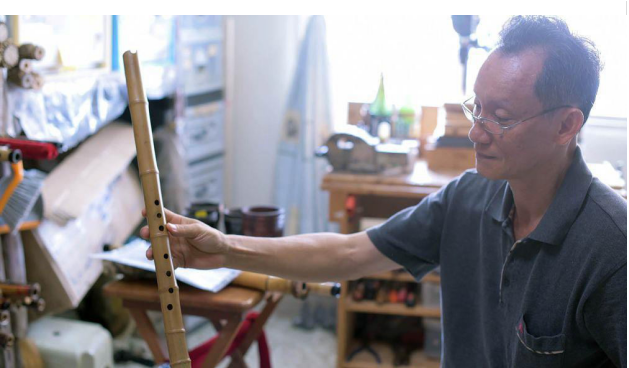
Mr Ng Teck Seng holds up a Japanese Shakuhachi flute which he made in his workshop. (Photo: Lam Shushan)
Mr Ng Teck Seng talks about what it’s like to have others believe in his dream after 20 years, his wife’s support, and what neighbours think of his home workshop.
SINGAPORE: He’s been called “inspirational” and even “a national treasure” by Singaporeans who were moved his story. But flute-maker Ng Teck Seng is unfazed by all the attention - even after 20 years of labouring at his craft in virtual anonymity.
The story of a Singapore craftsman who has quietly been making Chinese bamboo flutes (dizi) for world-class musicians, and who was recently invited to head a research team at the prestigious China Conservatory of Music, has created ripples.
Shared by Channel NewsAsia on its CNA Insider Facebook page, the story was shared more than 6,000 times since Sunday, and the video drew well over 200,000 views.
Linked to CAN Insider (Facebook): https://www.facebook.com/cnainsider/videos/1085317618157581/
But Mr Ng seems to shrug off all the compliments, with the single-minded focus that has driven him all these years - how to create the perfect Chinese orchestral sound. “I need to solve these problems with the acoustics in Chinese instruments,” is his practical response, when asked how he felt about the public attention.
Perhaps it’s because the 57-year-old believes he has no time for such distractions. “I have been putting more and more time into my R&D because I am ageing,” he says.
“A SUCCESSFUL MAN ALWAYS HAS A WOMAN BEHIND HIM”
In his original interview, Mr Ng had described the problem of how Chinese musical instruments were historically made to be played individually, and thus there is a dissonance when they come together in an orchestral arrangement - a relatively new development.
To solve this problem, since 1994, he has been conducting his own research to marry the Western science of instrument-making with Chinese tradition.
In the early years, he supported his R&D work by selling the flutes that he made and by giving music lessons. Not many people, including grant-givers, believed in what he was doing, he says.
Except for one woman - his wife of roughly 15 years, Yin Yin. “She strongly supports me,” he says. “When I travel to China, she paid for all my air tickets.”
Running a successful translation business, she is the main income-earner of the family (they have two school-going children). And as Mr Ng devotes more time to research, he has come to rely increasingly on her.
Says Mr Ng: “She likes music, that is why we got together. She recognises the value of what I am doing. We walk every morning… we have good companionship. It’s very important. A successful man always has a woman behind him supporting.”
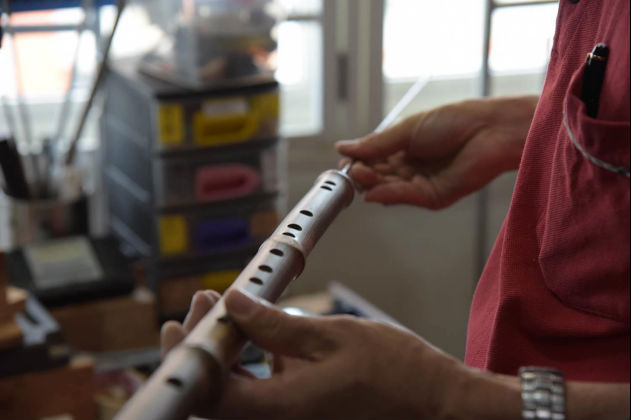
Mr Ng examining a flute that is in the making. (Photo: Ray Yeh)
The past year has been one of momentous breakthroughs for Mr Ng.
In October, he clinched the top award at the first international flute-making competition, where he was pitted against top makers from around Asia.
Shortly after, he was invited to lead a team in R&D at the China Conservatory of Music in Beijing. And just this month, he was granted financial backing by the National Arts Council (NAC), after unsuccessfully requesting funding from them in the past.
“The first person who reaches the top of the mountain always has it the hardest; no one believes that you can do it,” he says. “For the past 20 years, no one believed that I could do it, no one trusted me. That is the most difficult part. But I knew what I was doing.”
He adds, jokingly: “Now NAC starts to believe me… I won the special gold prize, and this and that, so they can support me because they don’t have that pressure that they are wasting taxpayers’ money anymore.”
“NO MAJOR PROBLEMS” WITH NEIGHBOURS
With his new-found fame in recent days, he has received multiple enquiries and orders for his flutes, from as far as Australia. But he says it is not his intention to cater to the masses.
“My career is mainly in R&D and not mass production. I want to make the best and only the best,” he says.
He also clarifies that “less than 10 per cent” of his flutes are made from “start to finish” in his HDB home. “One of the viewers said something quite interesting... how can I have a factory in a HDB? I can’t make so many in my 12-sqm space.”
Instead, he explains: “Some processes have to be done in China in a workshop that is run by my tudi (disciple) … but key processes I have to do myself, because these are strongly related to acoustics,” says Mr Ng who flies to China several times a year to select only the best works-in-progress to bring home to work on.
Responding to questions on social media about the noise from his home workshop, Mr Ng says in 30 years he has had no major problems with his neighbours.
“Upstairs, they say Huang Lao Shi (teacher Ng), your flute sounds so nice … most of them give positive feedback,” he says.
The only complaint he ever received was when he was renovating his flat years ago. “(The neighbours) actually did not realise I had a workshop because I put a soft pad at the bottom of the table, so it minimises the impact when I hammer.”
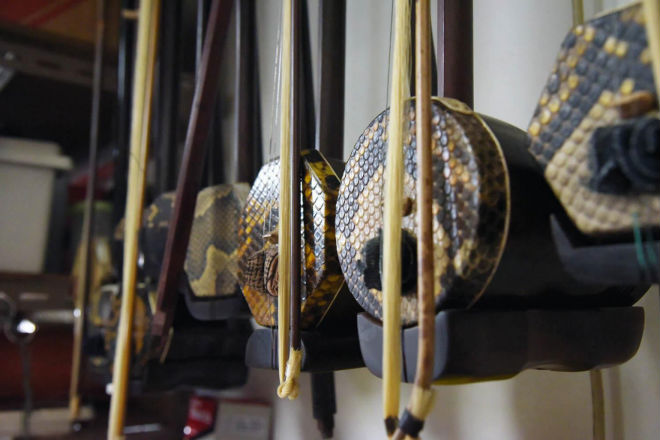
Mr Ng’s house is filled with Chinese instruments that he hangs up on the walls.
(Photo: Lam Shushan)
MAKERS LIKE HIM ARE “CRUCIAL TO MUSIC ECOSYSTEM”
Mr Ng’s other supporters include Mr Terence Ho, chief executive of the Singapore Chinese Orchestra.
Mr Ho says that in the “ecosystem” of Singapore Chinese music, aside from “musicians, conductors, composers, administrators and audience”, instrument-makers such as Mr Ng are essential for the industry to flourish.
“I am very proud of him - he's a Singaporean as good as a Chinese sifu (master) in China,” says Mr Ho. “If you talk about the top eight or nine Chinese orchestras in the world, I dare to say that the top dizi players use his dizi. He's quite well known,” says Mr Ho.
“If Teck Seng can produce an instrument and give it to a good musician, and the music can touch the heart of the people, he will be very happy… I hope to have more people like Teck Seng doing what they are passionate about,” he adds.
Mr Ng believes that with the backing of the organisations that are now supporting him, the most difficult part is over.
“In the beginning, I had too many constraints - the facilities, the space. But as what Lee Kuan Yew did with Singapore - if you want a tiny island to be successful, you have to be outstanding - so I am also fighting to be outstanding. I want to be the very best,” he says.
He heads to Beijing later this year to lead a team of 13 researchers at the China Conservatory of music, where he hopes to groom a team of successors.
- CNA/ss